It Didn’t Fall from the Sky
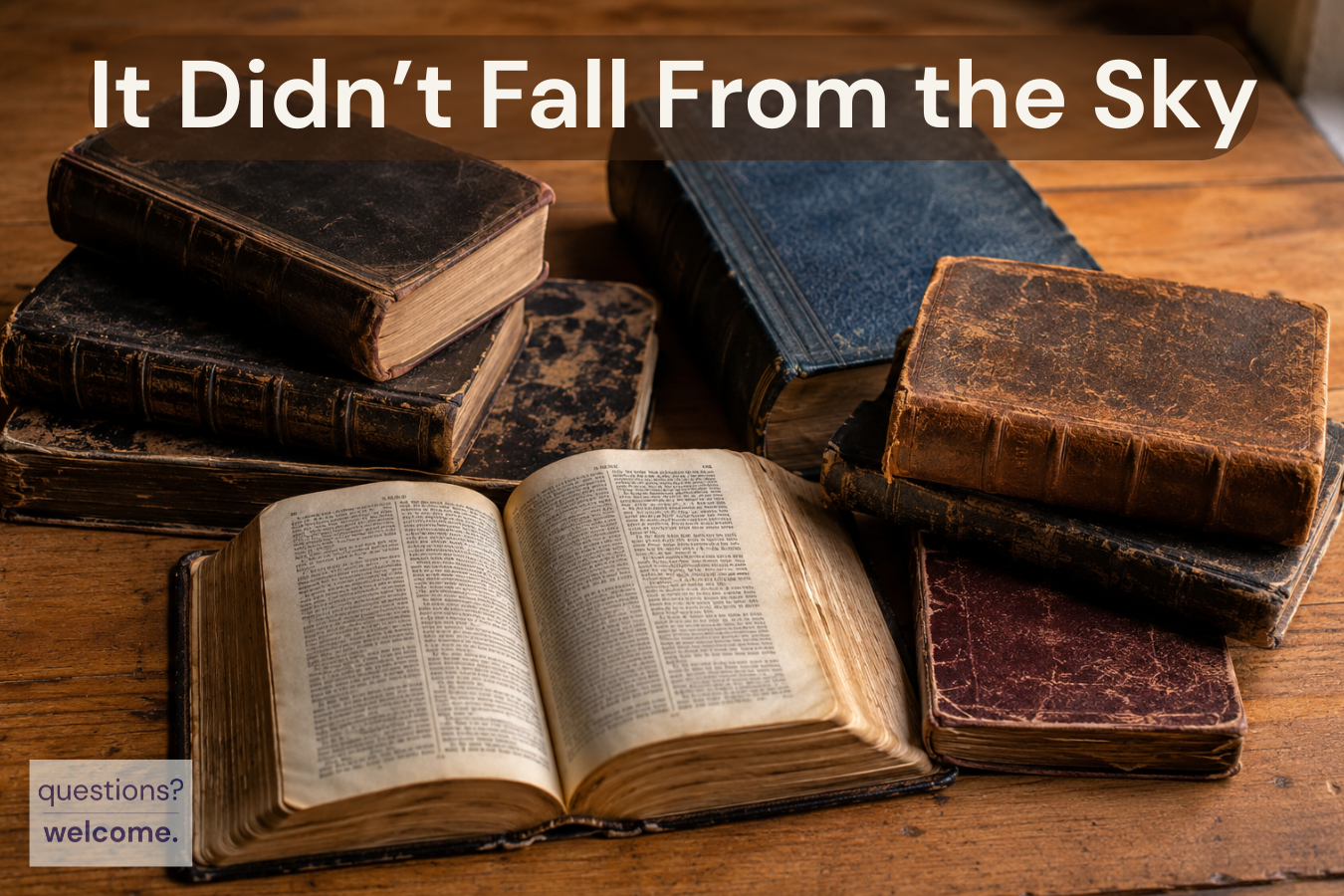
All summer long, the board outside the church office is collecting your questions — written on sticky notes, about God, faith, the Bible, doubt, or whatever else you’ve been carrying. Each issue, I take one or two and do my best to answer them.
Today’s question, exactly as asked:
“How did we get the Bible?”
Before we get into the history, it’s worth asking what this book actually is. Try this: the Bible isn’t one book so much as a library — the story of God and God’s people, told in law, history, poetry, prophecy, and letters, written across centuries by very different hands in very different circumstances. And underneath all that variety, nearly every page is doing the same basic work. It’s asking who God is. And who we are, in response.
That’s the story. Now — how did we get it?
Nobody sat down and wrote the Bible in one sitting. Long before there were scrolls, this story lived in memory and voice — spoken around fires, passed from parent to child, sung long before ink ever touched a page. The Old Testament took shape slowly, across roughly a thousand years, through the hands of prophets and poets, exiled kings and scribes whose names we’ll never know. The New Testament came together far faster — within a lifetime or two of Jesus, as his earliest followers wrote letters to young, struggling churches and set down what they had seen and heard.
None of it was written in English. The Hebrew Scriptures came first, with a portion in Aramaic. The New Testament writers used Greek — not the polished Greek of philosophers, but the everyday trade language spoken across the Mediterranean. Scripture was never locked away in some sacred, specialist tongue. From its first breath, it was written in the language people used to haggle at the market.
So who decided which books belonged? Here the story gets more human — and more contested — than most of us were taught. Over centuries, the church argued and prayed its way toward consensus: which texts had actually shaped worship and teaching, generation after generation, community after community? Nobody voted on it in an afternoon. And here’s something worth knowing: that consensus never became total agreement across the whole Christian family. Protestant Bibles hold sixty-six books. Catholic Bibles include several more — Tobit, Judith, Wisdom, and others — and Orthodox communions expand the list further still. Our own Reformed tradition, like the Anglican communion, has long read some of those additional texts without treating them as equal in authority to the rest. Different branches of the Christian family, to this day, carry slightly different Bibles on their shelves. That’s not a scandal to hide. It’s what a genuinely human, centuries-long process actually looks like.
And then, once gathered, this book still had to be translated — again and again, into whatever language people actually spoke. Our own Westminster Confession insists on exactly this: Scripture translated into the language of every people, so the Word of God might dwell plentifully in all of them. That’s why you’re reading English right now instead of Hebrew or Greek, and why translation has never really stopped. The New Revised Standard Version, which we read most often here at Pine Ridge, describes itself as one more step in a centuries-long relay — revising the Revised Standard Version of 1952, which revised the American Standard Version of 1901, which revised the King James Version of 1611. Each revision responded to something new. Ancient manuscripts like the Dead Sea Scrolls surfaced decades after earlier translators had done their best work with what they had. And each translation, its own scholars will tell you plainly, remains unfinished — ready to be refined again the moment the next discovery demands it.
None of this threatens what the Bible is. Not the disagreement over which books belonged. Not the retranslating, generation after generation. Our own confession says plainly that Scripture’s authority never rested on the people who copied it, translated it, or argued over its edges. It rests on God. The process was real. The ownership was never in question.
So: not a book that fell from the sky, fully formed. A story about God and God’s people, carried by countless hands across three thousand years — still asking, on every page, the same question it always has: who is God, and who are we, in response?
Knowing how we got this book is one question. Knowing how to read it well — honestly, together — is the next one. That’s exactly where we’re headed on July 19: What Is the Bible, and How Do We Read It? I hope you’ll be there.
More questions are waiting on the board, and I’ll be back with another in the next issue. You can add yours on a sticky note on the board outside the main office — or send them directly to me via my contact page. Anonymous is always fine. Every question is worth asking.