June is Pride Month. I celebrate it. Openly, joyfully, and without apology.
If you're new here, or if you've been wondering where this pastor stands — now you know.
I celebrate Pride because I believe what I preached last Sunday, and the Sunday before that: we love because God first loved us. Not some of us. Not the theologically tidy among us. All of us. If that is true — and I believe with everything I am that it is — then the full welcome and belonging of our LGBTQIA+ siblings is not primarily a social question. It is a theological one. And in a year like this one, it is also an urgent one.
The Moment We're In
Last month, the White House released its 2026 United States Counterterrorism Strategy. Several pages into that document, people described as "radically pro-transgender" are identified as part of the nation's terrorism landscape.
The Presbyterian Church (USA)'s own Advocacy Committee for LGBTQIA+ Equity responded within days: To affirm the dignity of transgender people is not terrorism. To protect trans children is not extremism. To feed the hungry, shelter the vulnerable, accompany the rejected, and love our neighbors without condition is not anti-American.
I am proud to serve in a denomination that said that out loud. And that statement points to something the church has needed to grapple with honestly for a long time — because the way Christian communities have treated LGBTQIA+ people has been anything but loving.
The Asterisk
Drive past nearly any church in America and you'll see a sign: All Are Welcome!
Beautiful sentiment. Often an incomplete truth.
What the sign rarely tells you is what comes after the asterisk. Welcome — as long as you sit quietly and don't expect to belong. Welcome — as long as your family looks like ours. Welcome — as long as you leave the parts of yourself that make us uncomfortable at the door.
I have sat with people who came to church with hope and found the asterisk waiting for them. They stayed long enough to learn the unspoken terms and conditions. Then they left — quietly, without making a scene, because the church had taught them their presence was conditional. In too many cases, they didn't come back. Not to that church. Not to any church.
What I've come to believe — and what I try to practice at Pine Ridge — is that the church is called to something far more demanding than welcome. We are called to want one another.
The difference matters. Welcome says: it's fine if you're here. Wanted says: we are not complete without you. Welcome says: we'll make room. Wanted says: we've been saving your seat.
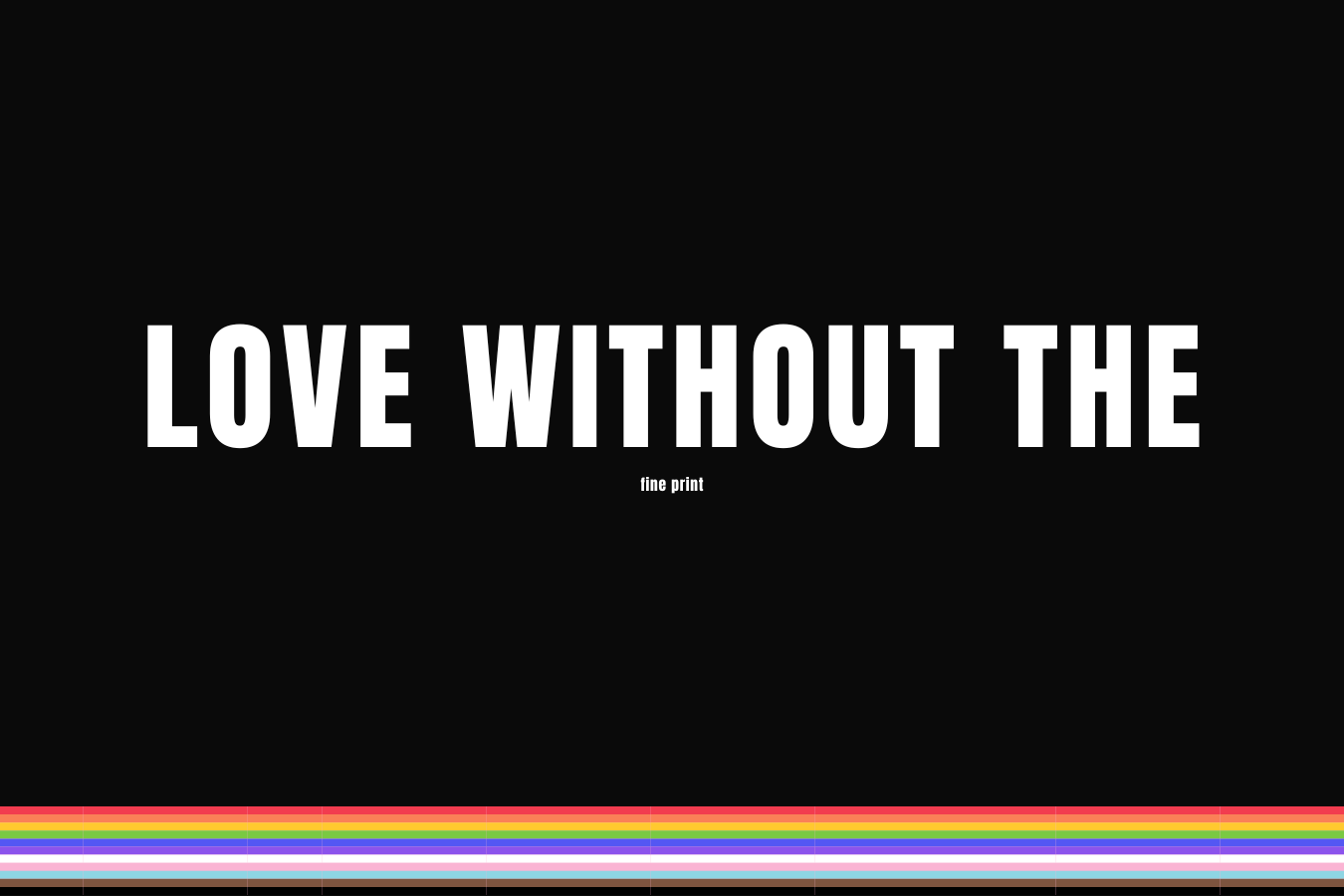
I first encountered the phrase love without the fine print through the work of David Hayward — better known online as @NakedPastor — a Canadian pastor-turned-artist with a rare gift for naming what the church often cannot quite bring itself to say. The phrase has become part of my own theology because it captures exactly what I believe the gospel demands of us. Not love with conditions. Not love with exceptions. Love without the fine print. Which raises the obvious question: is that actually what the Bible teaches?
What the Bible Actually Says
It is a fair question, and I want to take it seriously.
The Reformed tradition I was trained in holds to what is sometimes called the Rule of Love: all biblical interpretation must be tested against Christ's command to love God and love neighbor. If our reading of any passage produces contempt rather than love, exclusion rather than belonging, we should look more carefully at our reading.
When I look carefully at the passages most often cited to condemn LGBTQIA+ people, I find something consistently overlooked: context.
Sodom's sin, named explicitly by Ezekiel, is pride and the neglect of the poor. Jesus references Sodom in the context of hospitality — not sexual ethics. The Levitical code sits in the same Holiness Code as dietary restrictions and prohibitions on mixed fabrics — part of a purity system the New Testament explicitly transforms. The "natural" and "unnatural" language in Romans reflects Greco-Roman social status norms, and the argument turns immediately in the very next chapter toward the universal human need for grace. These passages do not say what they are often claimed to say.
More importantly: the larger arc of scripture is not one of narrowing exclusion. It is one of expanding inclusion. The Spirit that led the early church to welcome Gentiles without requiring them to become Jews first. The Spirit that eventually led the church to condemn slavery, to ordain women, to affirm marriages that crossed racial lines — in each case after centuries of using scripture to justify the opposite. The church has been here before. And each time, the Spirit was already on the other side of the line we were so certain we should not cross.
That same Spirit has been moving through my own tradition for decades, and it has carried us somewhere I am genuinely proud of.
If you want to go deeper on the biblical conversation, I commend the resources at the Covenant Network of Presbyterians (covnetpres.org) — and specifically Letters to Jerri, a series of fifteen careful, honest essays by Rev. Dr. D. Mark Davis written for anyone genuinely wrestling with these questions from within a tradition that takes scripture seriously.
Where My Denomination Stands
The Presbyterian Church (USA) is unambiguous: sexual orientation and gender identity are written into our Constitution, explicitly named as categories against which this church of 1.3 million people does not discriminate. LGBTQIA+ people are fully welcome to serve in every office of ministry and leadership. Same-sex marriages may be performed by Presbyterian ministers and celebrated in Presbyterian churches. This is not a loophole or a local option — it is denominational policy, won through decades of discernment, debate, and the slow, persistent work of the Spirit.
Pine Ridge is a member of the Covenant Network of Presbyterians, working toward what they describe as "a church as generous, just, and truly inclusive as God's grace." I am proud of where we've arrived. I know the work is not done.
And in the middle of that ongoing work, I want to speak directly to you.
You Are Wanted
If you have been told the church has no room for you — that your identity is incompatible with faith, that you must choose between who you are and who you believe in — I want you to hear this clearly.
You are wanted.
Not welcomed with conditions. Not tolerated with fine print. Wanted — exactly as you are, in the full and particular uniqueness of how God created you. The God who made you is not embarrassed by you. The church that follows that God should not be, either. The loudest word in scripture, the one that holds up under the weight of everything else, is this: we love because God first loved us.
That love has no asterisk. It has no fine print.
If you're in the Kansas City area, we'd love to have you at Pine Ridge Presbyterian Church: pineridge.org
Nationwide: To find a welcoming congregation near you: covnetpres.org/cnp-churches